
Noise Monitoring & Assessment Surveys
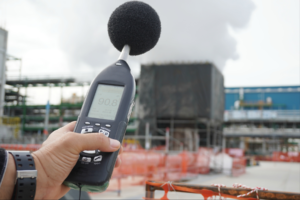
Apple environmental can assist by undertaking a noise assessment or a noise monitoring survey for you, by means of ambient noise levels or occupational exposure assessment, ensuring compliance with the Control of Noise at Work Regulations 2005.
Noise is effectively defined as unwanted sound. At low levels noise can result in irritation and annoyance but prolonged exposure to high noise levels such as during the working day can lead to serious health problems such as tinnitus.
What we do?
Apple Environmental can undertake any form of noise monitoring survey as part of any occupational exposure assessment, baseline survey, public complaint, environmental impact assessment, or planning application. The results can be presented as average or maximum levels, real-time plotted data showing fluctuating noise levels over a specified time period, frequency analysis and audio recording.
When may I need to undertake a noise assessment?
Planning
BS4142:2014+A1:2019
This is the method for rating and assessing industrial and commercial sound. A BS4142 assessment is not appropriate for non-human receptors or non-residential properties such as offices, schools or outdoor areas. It is used to assess whether the noise is likely to cause a significant adverse impact.
When would I need a BS4142 assessment?
A BS4142 assessment is required to assess noise from new or changed industrial or commercial premises, to accompany a planning application, or to assess noise which may give rise to complaints.
BS8233:2014
This is the method for guidance on sound insulation and noise reduction for buildings. It sets out appropriate internal and external noise levels for bedrooms, living rooms, dining rooms and gardens for day times and night times.
When would I need a BS8233 assessment?
When developing a residential dwellings, schools or hotels or if the site is close to a transport noise source. This is normally requested at the pre-planning application stage or as a planning condition. This assessment is to ensure that the development is compliant with the National Planning and Policy Framework.
CRTN Assessment
This is the calculation of road traffic noise. This assessment provides noise levels over an 18-hour day period at the receptor point from one or several road segments.
CRN Assessment
This is the calculation of railway noise. This assessment provides noise levels over an 18-hour day period at the receptor point.
Workplace Exposure
Under the Control of Noise at Work Regulations 2005 employers are required to prevent or reduce risks to health and safety from exposure to noise at work. To do this, employers must assess the risk of noise on the health and safety of employees. In doing so noise exposure monitoring may well be required.
Frequently Asked Questions?
What is a noise assessment?
Noise assessments take many forms, such as occupational exposure in the workplace or the impact that external noise may have on dwellings, such as traffic or industry etc.
Is a noise assessment a legal requirement?
Yes in the workplace. For planning purposes, the requirement is at the discretion of the planning authority.
How often should a noise survey be done?
For workplace noise, this depends on the workplace risk assessment. For environmental noise, this depends upon whether the noise level is likely to impact receptors.
How long does noise monitoring need to be undertaken?
It varies, depending on what type of assessment is required. In some instances it may need to be undertaken continuously over several days.
What workplace assessments can you undertake?
We can undertake personal dosimetry to assess an individual’s exposure to noise over a designated period, usually a full work shift. This accounts for both intensity of the noise and duration of the exposure, providing a more accurate representation of risk to hearing health.
We can also undertake background monitoring at one or several locations inside the workplace to determine noise exposure levels over an appropriate time period.
Do you undertake BS5228 Surveys for noise and vibration on construction sites?
No.
Do you undertake acoustic assessments for internal sound transmission?
No.

